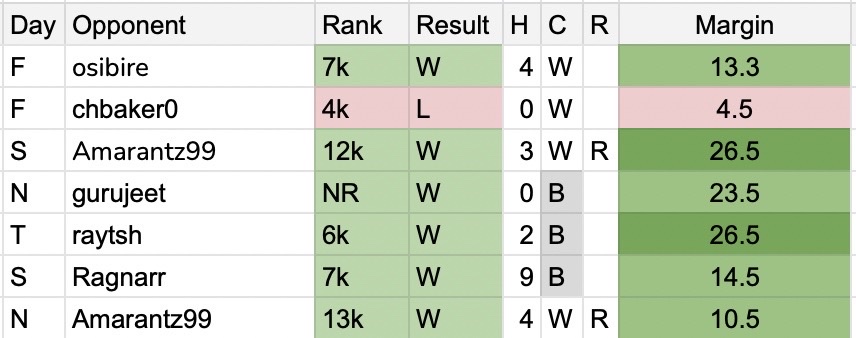
- The good news is that I won all but one of my games
- The bad news is that I played fewer games than I should
- The terrible news is that I played way too fast
My Live Play time was way down and needs to be improved.
The story of my studies as I stand in a seemingly perpetual "kyu"
My Live Play time was way down and needs to be improved.
The BenKyo League (BKL) is really taking off. In this past month alone seven new members have been added to the roster and more are on the way. There is no better time to join BenKyo League as we head into November likely to add one or even two new leagues to our Main Leagues.
Take a look at Tier 3 of Ben's Patreon to see what you get for $25.00 a month. You get three interactive group classes a month and access to all of the previous Group Class Videos. There are currently twelve of them to study.
You get special sgf files too. You get participation in a Main League where you get games with players close to your rank, handicapped as appropriate. You compete in the main league for prizes of Twitch Lesson Time with Ben. First and second place in each Main League get a prize. You are guaranteed at least one review of a Main League game from Ben for the month and likely more if you play a lot of games.
The Title Tournament is a chance to compete for fun titles against all league players. You can play each one up to three times in the course of the month.
You get a game with Ben either one-on-one if you are in the A League, or a simul game if you are in B or C league.
I could go on, but check out his Patreon for more details.
If you decide to join BenKyo League tell him that buzzsaw sent you.
Now for my usual content...
This is what my week looked like.
I played 9 games last week and lost five of them. It is a fairly even result, but it didn't feel that way. I'm not counting the teaching games with Clossius and BenKyo Baduk.
As for Essential Go Activities...
It was pretty one sided with all of my time spend on Live Play.
Ben Mantel, BenKyo Baduk, has suggested that I play fewer games and spend more time reviewing the games I play. He also believes that it would be beneficial for me to memorize a few things. To that end he has started to take advantage of the OGS variation feature which allows you mark variations in a game record. This feature can be used in a Game Review.
In the image above there are three important elements.
From left to right we have my MacBook Pro, my Cat, and my iPad Pro with Magic Keyboard.
On the MacBook Pro I have the Game Review which has a great many Variations added. The cat is just sleeping. On the iPad Pro I have the video of my lesson opened. As I watch the video I can stop and hover over variations or click on them to replay them move by move.
Although it takes a bit of time in the lesson for Ben to enter the variations I think that it is going to be time well spent if it makes the sgf of the Game Review more useful. I've always thought that watching my lesson videos is valuable but have sometimes been frustrated trying to find things in the sgf that I want to click through to memorize or replay.
Now for my usual weekly content:
My post for this week is coming a bit late. I'll be following up with a post abut another week in a few days. The week was heavy on Live Play and very light on Review and Go Problems.
I decided to have Yilun Yang give me reviews of my two most recent AYD League Games. And I got the brilliant idea of actually linking to a review that another BenKyo League Member did of one of my BenKyo League Games.
BTW, if you show up for a Clossius Game Review Stream there is a possibility that you might be gifted a free one month membership in his league. He did that for one person in stream in the last two streams I attended. He is streaming more often now, so be on the look out for a link to his stream in the upper right corner on OGS.
Whoops. I meant to do more Go Problems this week, but failed.
I spent about four hours on Essential Go Activities, most of which were devoted to Live Play.
I played six games this week.
Before I show my Essential Go Activities chart for the week I would like to talk about my recent homework from Ben Mantle. Ben decided that some joseki study would be a good addition at this point in my go development.
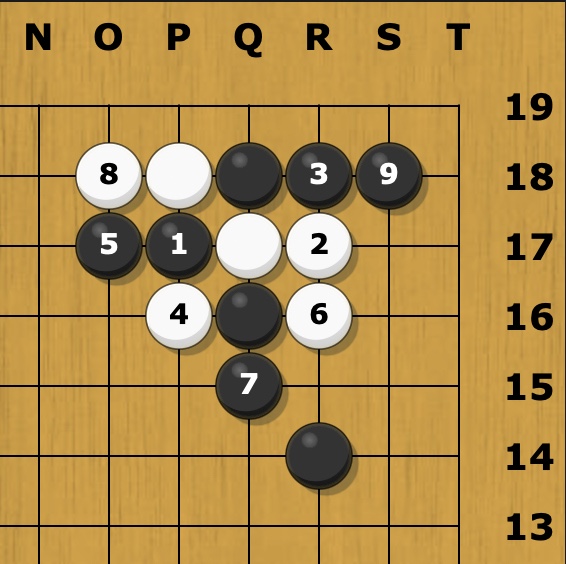
The diagram above is from AI Sensei. It is from the game that Ben and I reviewed in my lesson from September 1st. In that game I had stepped back when my opponent played the q17 wedge. Ben told me that I should have given atari from the outside, and AI clearly agrees. Ben spent about 15 minutes of our 90 minute lesson explaining how this joseki can go.
Ben suggested that I memorize this and use it in my games. Not only should I give atari at A when I am black, but I should also try wedging at q17 as white.
I definitely saw the value of learning this joseki, but I was skeptical of my ability to memorize it simply by rewatching the video a number of times. I decided to invest a good deal of time creating a demo file to study.
Rather than using the sgf of the review on OGS as a starting point I decided to create the demo file from scratch in SmartGo One on my iPad while watching the video of my lesson. The fact that OGS numbers the moves of a variation was quite helpful in this process. I needed to watch a few seconds at a time and add the variations in the demo file while meticulously typing in Ben's comments. This process helped to cement the variation in my mind.
The aim was to be able to review the sgf file at my own pace and read the comments so I would be able to understand the reasons behind the moves. I am not proud that it took me about three hours to create this demo file. However, I am pleased that after doing so it only took me between 30 minutes to an hour to be able to master replaying the main line of this joseki. Below is the main line of the joseki without the forcing moves white gets to play at the end starting at n17.
There are some other gems I need to memorize from some of my other lessons with Ben, and I think that I can probably do better creating the demo files in the future now that I have made one successfully.
I even played out the joseki on a real board.
Above I have played the joseki out with one of white's forcing move continuations. This can actually be played out with the black shimari facing in the opposite direction and also with switching the colors. So it can be played out 16 different way.
I'm looking forward to doing more joseki study.
Now for my Essential Go Activities chart:
I spent about six and a half hours playing go this week.
Though I am showing details on only the Essential Go Activities this week, I did record other activities. I spent a little over 11 hours on Nonessential Go Activities such as lessons and watching go videos.
In my lesson with Ben Mantle on Wednesday we decided to put an emphasis on looking at attacking in my game reviews. In preparation for my lesson on Thursday I played four games as BuzzKill on KGS. We reviewed three of them. I'm going to keep trying to play more games as BuzzKill and working to recognize the weaknesses of my opponent.
In our Thursday lesson Ben showed me that I should play at 1 in the upper right and how to continue. I'm supposed to memorize this.
I think I'm going to have to make a demo file and type in the explanations from the lesson. That ought to help me.
I brought home a t-shirt from the Go Congress to remind everyone where my priorities lie. Go is more important than housework.
I've boiled my Go Activities down to three essential activities, and I have stopped recording other activities even though I am still engaging in other activities such as taking lessons and reviewing videos about go. For the time being I am just recording three essential activities. I'll be naming them later in the post and providing a pie chart of how my week stacked up.
I was prompted to rethink my plan for my go studies based on some feedback from In-seong Hwang.
I had my two hour Special Training review session with In-seong Hwang on Tuesday. It was part of the Special Training for the Go Congress that I decided to take part in. In a two hour session we reviewed all five of my U.S. Open games. After that we had enough time left to review one of my Die Hard games which I happened to lose by only 1.5 points.
I made it a point to tell In-seong that I believed that one of the reasons I did poorly this year is because I never play over the board except at the Congress, and it had been three years since I played over the board. And it has been about ten years since I played over the board anywhere other than once a year at the Go Congress, and I have not attended all of them in that time period.
In-seong said that after going over my six games that he believes that my territorial intuition is much stronger than he previously recognized. He said that my opening play was sometimes Dan level. I think that one of the reasons my territorial intuition was shown off to best advantage is that I was not playing even games against players three or four stones stronger than myself as I often must do in Yunguseng Dojang. I think it makes a difference.
We talked about playing to one's strength to win in a tournament, which I was attempting to do at the Congress at his suggestion, as opposed to trying to play well, which is what I need to do when I play games for Yunguseng Dojang. Some of the moves that were proper for me to play in a tournament game In-seong would not want to see me playing in a Yunguseng game because he would want me to be playing more aggressively. I think I understand what he is saying about the difference between tournament play and Yunguseng play.
He wants me to get more game experience, specifically related to technical things.
He wants me, over the course of the next few months, to play150 aggressive games.
Last week I had actually decided to play nothing but required league games for a while, but I think In-seong is right that I won't get any stronger if I don't change my emphasis and get more technical experience. I don't think I will miraculously get stronger just by playing a lot of games and getting a lot of game experience, but it won't hurt either.
He asked me if I had ever played any 10 second games, by which I assumed he meant blitz with only 10 second overtime periods. I told him that I had actually done really well with blitz, but that it hadn't helped to break my tendency to play too fast, and it had not helped with my reading either. But I think he wants me to do some intuitive playing. I guess that won't hurt.
He asked about how many lessons I am taking, and he felt that four hours of lessons a week is too much. I told him that I didn't want to have any of my teachers unemployed. I'm not about to cut back on lessons. But he does have a point about the way I am using that time. I should probably stop doing teaching games with Yang and start reviewing games instead. I am sure I can cover three games with Yang in one 90 minute lesson. And spending the time necessary to review my games to find the right three games to get reviewed by Yang would have to be beneficial.
After double checking how much time I am devoting to lessons it actually comes to a little less than three hours a week rather than four hours a week, so it isn't as much as it appears to be at first glance.
I am going to rise to the challenge of playing more games for In-seong and see how it goes. I'll even play some blitz so I get more experience.
I've decided to change the way I keep track of my study time for awhile, and clock only three activities: playing games, reviewing games, and solving go problems. That doesn't mean I won't be doing other things like taking lessons, reviewing past lessons, or watching people play. I just won't be recording that time. I will only be recording those three essential activities and see how that goes.
Here is how my week panned out according to my new system:
I set up these three activities as child activities of the parent activity Essential Go Activities. By doing this I will actually be able to filter my chart so it shows only the Essential Go Activities incase I add back tracking other activities.
Take a look at the difference between last week and this week.
I lost every game last week except the one game I played with the app called Just Go.
This week I won every one of my games. All of them were won by resignation except the escape on Fox where I was winning by about 27 points and my opponent refused to accept scoring.
I managed to achieve a ridiculous rank on KGS in my quest to establish a rank for my BuzzKill account. That rank won't last for long. I expect to settle in at about 6k.
I chose 7k as my estimated rank when I started to play on Wednesday. After an undeserved win by resignation I was 4k?. After a deserved win against a 3k I became a 1k?.
In the week ahead I am going to try to play more games than usual and review them all. I'll keep doing go problems too.
It was a busy week of Go Activities with over 50 hours spent, but very little of that time was spent playing go. I played six games since the Congress and lost all of them. I'm in desperate need of a break so I am taking one.
I spent an amazing 17 hours finishing the Anime series Hikaru no Go. I feel like I need to find something else to watch now.
I am taking a break from playing go after the U.S. Go Congress. I really need it.
It is my plan to play only league games for the next month, and to not play any rated games. If I get to the point where I am actually winning more games than I am losing I will consider playing some rated games. If not I will just continue with league play.
I was disappointed with my performance at the Congress. I went 2:3 in the U.S. Open, the games for the Open have not yet been entered into the database for the AGA. The Die Hard games, in which I went 1:4 have been entered into the database. The good news is that I only lost 0.04 ratings point as a result of my terrible performance. That gives me hope that I will hold onto my 9k rating by the skin of my teeth since I am unlikely to lose the 0.15 of a rating point necessary to dip me into the 10k range. My sigma did increase from 0.35 to 0.52 though so there may be more damage than I anticipate.
The good news is I am likely to get to play as a 9k next year. The bad news is that I'm likely to do as poorly as I did this year again next year.
The TD for the Open was very strict about allowing self promotions this year insisting on a three stone self promotion rather than the usual two stones required. As a result there were totally new players who had the option of choosing their starting point based on their perceived strength while you had veteran players who had not had a rated game in three years unable to self promote even though they felt as if they were stronger, but not three stones stronger.
It is going to take a couple years for the ratings to shake out.
One of the things I am likely to do in the next month is to review some of my lessons from the past year.